


Cartier Santos Watch Guide

Updated: Aug 8
The Complete Collector’s Guide to Cartier Santos Watches

History, Evolution, Model Comparisons & Why the Santos Remains One of Luxury Watchmaking’s Greatest Icons
⸻
Introduction
Few wristwatches can claim to have changed the course of horological history. The Cartier Santos is one of them.
Today, the Santos is recognised for its distinctive square case, exposed bezel screws and seamless integration of bracelet and case. Yet beyond its instantly recognisable appearance lies an extraordinary legacy: it is widely regarded as one of the world’s earliest purpose-built men’s wristwatches.
Long before wristwatches became mainstream, gentlemen still relied on pocket watches. The Santos helped change that forever.
More than a century after its creation, it remains one of Cartier’s most enduring collections—continually evolving while retaining the design language that made it famous.
⸻
The Birth of the Cartier Santos
The Santos story begins not in a watchmaking workshop, but in the skies.
In the early 1900s, Brazilian aviation pioneer Alberto Santos-Dumont was one of the world’s most celebrated inventors and pilots. While flying his aircraft, he found pocket watches impractical—removing both hands from the controls simply to check the time was inconvenient and potentially dangerous.
His close friend Louis Cartier designed a solution.
Around 1904, Cartier created a wristwatch that allowed Santos-Dumont to read the time instantly while flying.
Although wristwatches existed before this period, they were largely considered jewellery for women. The Santos was among the very first wristwatches specifically designed for men with everyday practicality in mind.
Its success helped accelerate the transition from pocket watches to wristwatches throughout the twentieth century.
More than 120 years later, the Santos remains one of the few luxury watches whose origins can be traced to solving a genuine real-world problem rather than simply following fashion.
⸻
The Design DNA of the Santos
Despite countless iterations over the decades, every Cartier Santos shares several defining characteristics.
Square Case
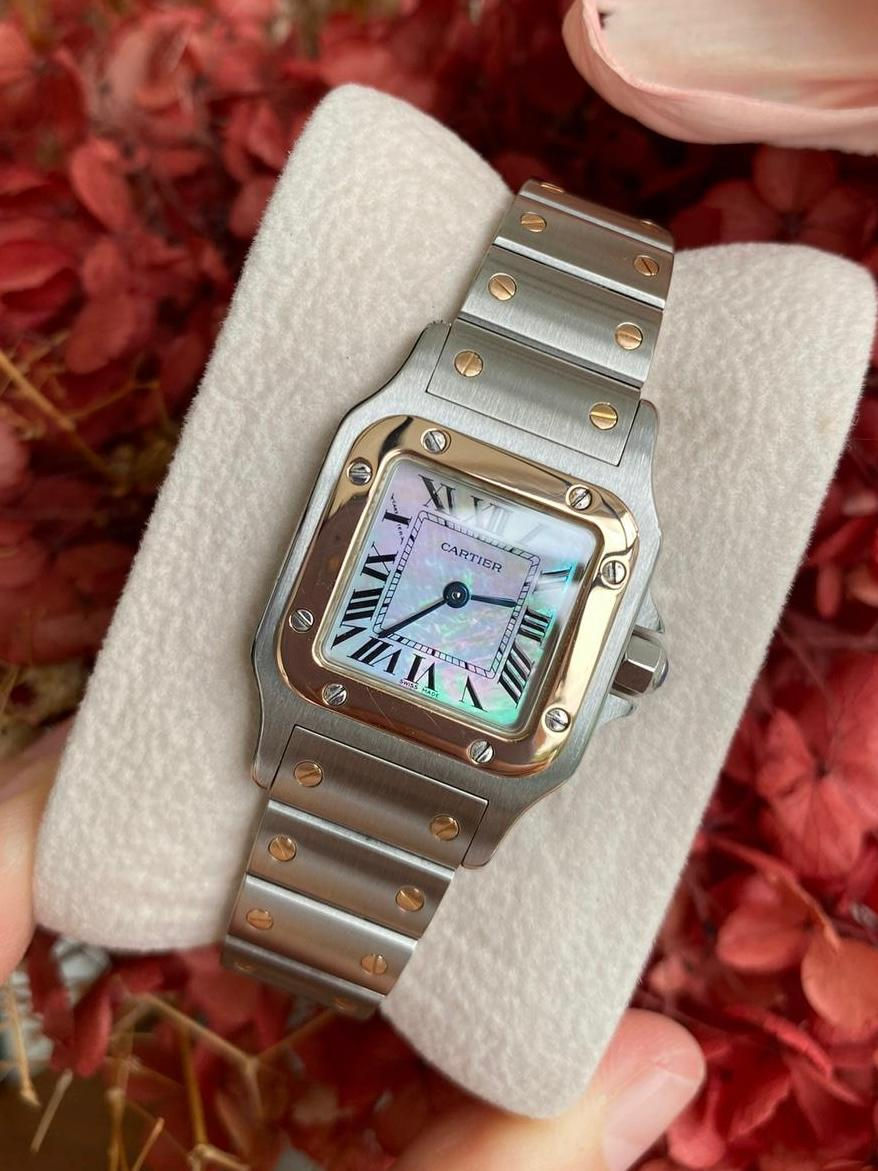
Unlike the overwhelming majority of round watches, the Santos embraces a geometric square profile that immediately distinguishes it from traditional sports watches.
Its proportions allow it to wear elegantly without appearing overly formal.
⸻
Exposed Bezel Screws
Perhaps no feature is more iconic than the visible screws surrounding the bezel.
Originally functional elements, they have since become one of Cartier’s most recognisable design signatures.
The industrial appearance was revolutionary during its era and continues to feel surprisingly modern today.

⸻
Roman Numerals

Large Roman numeral hour markers remain one of Cartier’s strongest visual identities.
Combined with blued sword-shaped hands, they instantly communicate that the watch belongs to Cartier—even from across a room.
⸻
Railway Minute Track
Nearly every Santos features Cartier’s traditional chemin de fer (“railway”) minute track surrounding the dial.
It adds visual precision while reinforcing Cartier’s longstanding design language across many collections.
⸻
Integrated Bracelet
Modern Santos bracelets flow almost seamlessly into the case.
Rather than appearing like a separate attachment, the bracelet feels like an extension of the watch itself—creating a cohesive architectural silhouette.
This integrated look has become increasingly desirable among collectors in recent years.
⸻
The Evolution of the Santos Collection
Rather than replacing older designs entirely, Cartier gradually evolved the Santos over successive generations.
Each era developed its own personality, proportions and collector following.
⸻
Cartier Santos Carrée

Era: Late 1970s–1980s
The Santos Carrée (“square” in French) marked Cartier’s transition into the modern luxury sports watch era.
Compared with later models, the Carrée features:
• Sharper case edges
• More angular bracelet links
• Compact vintage proportions
• Thin profile
• Highly architectural appearance
Many collectors appreciate the Carrée for preserving the bold industrial aesthetic introduced during the golden age of integrated-bracelet luxury watches.
Movements vary between automatic and quartz depending on reference and size.
Today, original Carrée models remain increasingly difficult to source in excellent condition, particularly full sets.
⸻

Cartier Santos Galbee
Era: Late 1980s–2018
The Santos Galbée (“curved”) refined the Carrée without abandoning its identity.
Rather than sharp edges, Cartier softened nearly every surface.
Key differences include:

• Curved case profile
• More ergonomic bracelet
• Smoother transitions between links
• Improved comfort
• More rounded overall appearance
Many enthusiasts consider the Galbée to be one of the most wearable vintage luxury watches ever produced.
The collection was offered across:
• Quartz
• Automatic
• Ladies
• Mid-size
• XL
• Steel
• Two-tone
• Solid yellow gold
Neo-vintage Galbée watches remain exceptionally popular because they offer unmistakable Cartier aesthetics at relatively accessible prices compared to current retail offerings.
⸻

Cartier Santos 100
Era: Introduced 2004
Created to commemorate the Santos’ centenary, the Santos 100 represented a dramatic departure from earlier elegance.
Everything became larger.
Everything became bolder.
Characteristics include:
• Oversized case dimensions
• Thick bezel
• Broad Roman numerals
• Wide leather straps
• Greater wrist presence
• More contemporary proportions
Unlike the refined Galbée, the Santos 100 projects confidence and sportiness.
Most models utilise automatic mechanical movements, making them highly practical daily wear watches.

Today, discontinued Santos 100 references remain popular among collectors seeking a larger Cartier sports watch no longer available in the current catalogue.
⸻
Cartier Santos-Dumont

The Santos-Dumont pays tribute to the original 1904 watch.
Where the standard Santos has gradually become a luxury sports watch, the Dumont remains distinctly dress-oriented.
Characteristics include:
• Slim case
• Elegant proportions
• Minimal thickness
• Refined lugs
• Leather straps
• Lightweight construction
Many Santos-Dumont references utilise high-accuracy quartz movements, allowing the case to remain exceptionally thin.
Higher-end precious metal editions may feature hand-wound mechanical calibres, celebrating traditional watchmaking while maintaining the watch’s elegant profile.
Collectors who appreciate understated sophistication often gravitate toward the Dumont over the more robust Santos models.
⸻
Cartier Santos Octagon

Era: Introduced late 1970s / early 1980sThe Santos Octagon represented one of Cartier’s most distinctive interpretations of the Santos design language.
The square became eight-sided.
The industrial character remained.
Characteristics include:
• Distinctive octagonal bezel
• Exposed bezel screws
• Integrated metal bracelet
• Classic Roman numeral dial
• Compact vintage proportions
• Available in steel and two-tone configurations
Unlike the traditional square Santos Carrée, the Octagon introduces a more geometric and unconventional profile while retaining the signature elements of the Santos family.
Models were produced with both quartz and mechanical movements, with automatic variants being particularly appealing to collectors seeking a distinctly vintage Cartier with mechanical character.
⸻
Modern Cartier Santos

In 2018, Cartier comprehensively redesigned the Santos while carefully preserving its heritage.
Notable innovations include:
QuickSwitch Bracelet System
Owners can swap between bracelet and leather strap without tools.
⸻
SmartLink Bracelet Adjustment
Selected bracelet links can be removed without visiting a watchmaker.
This practical innovation makes sizing significantly easier than traditional pin-and-collar bracelet systems.
⸻
Enhanced Ergonomics
The modern case curves more naturally around the wrist, improving comfort despite larger dimensions.
⸻
Improved Movements
Many current models utilise Cartier’s automatic calibre 1847 MC, designed with improved resistance to magnetic fields and everyday reliability.
⸻
Mechanical vs Quartz Santos
One of the unique strengths of the Santos family is the availability of both mechanical and quartz movements.
Mechanical
Advantages:
• Traditional watchmaking
• Sweeping seconds hand
• Greater collector appeal
• Long-term serviceability
• Appreciated by enthusiasts
Ideal for:
Collectors who enjoy horology and intend to wear their watches regularly.
⸻
Quartz

Advantages:
• Extremely accurate
• Low maintenance
• Convenient
• Slimmer cases
• More affordable entry point
Ideal for:
Owners seeking Cartier design with everyday practicality.
Neither movement is inherently “better”—they simply cater to different lifestyles.
⸻
Steel, Two-Tone or Full Gold?
Stainless Steel

The most versatile choice.
Perfect for daily wear and often the most accessible entry into the Santos collection.
⸻
Two-Tone (Steel & Gold)
Perhaps one of Cartier’s signature aesthetics.
The contrast between polished gold screws, bezel and bracelet links creates a warm elegance without the commitment of full precious metal.
Certain discontinued two-tone references have become increasingly difficult to source, particularly in complete sets and well-preserved condition.
⸻
Full Gold

Among the most luxurious Santos executions.
Solid yellow gold and rose gold references carry remarkable wrist presence while preserving the collection’s timeless architecture.
Many discontinued precious metal references were produced in relatively modest numbers compared to steel variants, contributing to their rarity on today’s secondary market.
⸻
Why Collectors Love the Santos
The Santos occupies a unique position within luxury watchmaking.
Unlike many sports watches, it transitions effortlessly between formal and casual settings.
Collectors consistently appreciate it for several reasons:
• One of the earliest purpose-designed men’s wristwatches.
• More than 120 years of uninterrupted design heritage.
• Instantly recognisable without being ostentatious.
• Comfortable integrated bracelet architecture.
• Available across vintage, neo-vintage and modern generations.
• Broad range of sizes suitable for both men and women.
• Strong historical significance within Cartier’s watchmaking legacy.
• Distinctive square case offers variety in collections dominated by round watches.
Perhaps most importantly, the Santos has never relied on passing trends.
Its enduring appeal comes from timeless design rather than novelty.
⸻
Buying Tips for Collectors
When evaluating a pre-owned Cartier Santos, consider:
• Original bracelet stretch and overall condition.
• Sharpness of bezel screws and case edges.
• Matching dial, hands and movement for the reference.
• Presence of original Cartier box and papers where available.
• Bracelet length and number of removable links.
• Service history for mechanical models.
• Signs of excessive polishing, which may soften the watch’s distinctive geometry.
As with many iconic luxury watches, originality and condition often matter more than age alone.
⸻
Curator’s House Note
At WLCSG, the Cartier Santos remains one of our favourite watch collections, and one that we continue to believe in for the long term.
Its historical importance, unmistakable design language and remarkable versatility have enabled it to remain relevant for more than a century—an achievement very few watch collections can claim.
Certain discontinued full gold and two-tone Santos references have become increasingly scarce on the secondary market, particularly examples preserved in excellent condition with their original accessories. For collectors seeking something beyond the ordinary, these rarer configurations can be especially rewarding to own.
At the same time, the collection remains refreshingly accessible. Stainless steel Santos models continue to offer one of the strongest entry points into Swiss luxury watch collecting, combining genuine horological significance with everyday practicality.
For ladies who admire the Santos but prefer not to pay current boutique retail prices, vintage and neo-vintage Santos models often represent exceptional value. Many offer timeless Cartier aesthetics, comfortable proportions and enduring wearability at a compelling price point on the secondary market.
In our view, the Cartier Santos is far more than an iconic watch—it is a cornerstone of modern wristwatch history. Whether in steel, two-tone or solid gold, we believe it is a collection that will continue to be admired, collected and worn for generations to come.


Comments