


The Engineering Behind Bulgari Serpenti
Updated: Aug 2
How a Rigid Gold Snake Comes to Life

Gold is naturally substantial, precious and comparatively rigid. A serpent, by contrast, is defined by movement. The genius of Bulgari Serpenti lies in persuading one to behave like the other.
Few jewellery motifs are as immediately recognisable as Bulgari’s serpent. Its pointed head, hypnotic eyes and coiling body have appeared as rings, bracelets, necklaces and watches—sometimes highly stylised, sometimes almost anatomically lifelike.
Yet Serpenti’s visual symbolism tells only half the story.
A convincing serpent must curve around the body, remain comfortable in motion and preserve the controlled tension that gives it presence.
The challenge is not simply to create jewellery shaped like a snake. It is to make precious metal appear alive.

The Birth of Bulgari Serpenti
The serpent existed as a symbol long before Bulgari adopted it.
Across ancient Greek and Roman traditions, snakes were associated with wisdom, vitality, protection, renewal and rebirth. Their ability to shed their skin made them a natural emblem of transformation—a meaning that remains central to Serpenti today.
Bulgari introduced its first Serpenti creation in 1948 as a bracelet-watch. The earliest versions paired a flexible coiled body, made using the Tubogas technique, with a geometric watch dial. Rather than simply resting on the wrist, the watch wrapped around it.
During the 1950s and 1960s, Serpenti became increasingly figurative. Gold elements began to imitate scales, coloured enamel reproduced snakeskin patterns, gemstone eyes added expression and some watch dials were concealed beneath hinged serpent heads. By the 1970s, Bulgari was moving confidently between naturalistic serpents and highly graphic Tubogas forms.
This evolution is essential to understanding Serpenti. It is not one fixed design, but a creative language that Bulgari has continually adapted across jewellery, watches and high jewellery.

One Serpent, Several Forms of Engineering
Although Serpenti pieces share a visual identity, they are not all constructed in the same way.
A Tubogas watch, a flexible Viper bracelet and a high-jewellery necklace solve very different mechanical problems:
A ring must flex or open sufficiently to be worn while remaining secure on the finger.
A bracelet must accommodate wrist movement without feeling unstable.
A necklace must drape naturally while keeping its head correctly oriented.
A watch must combine a flexible jewellery body with a functional timekeeping case and movement.
That distinction explains why Serpenti cannot be reduced to one secret spring or one universal mechanism.
Its “life” comes from several different approaches to articulation.

The Mechanism and Flex of Serpenti Rings

At first glance, many Serpenti rings resemble a solid coil of gold. In reality, the sensation of movement often comes from the way the form is divided into repeating sections.
The scale as a functional unit
One of the defining characteristics of Serpenti Viper rings is the way each individual scale contributes to the illusion of one continuous serpent. While visually seamless, the articulated construction allows the ring to move naturally while preserving its sculptural form.

How Serpenti Bracelets Coil Around the Wrist
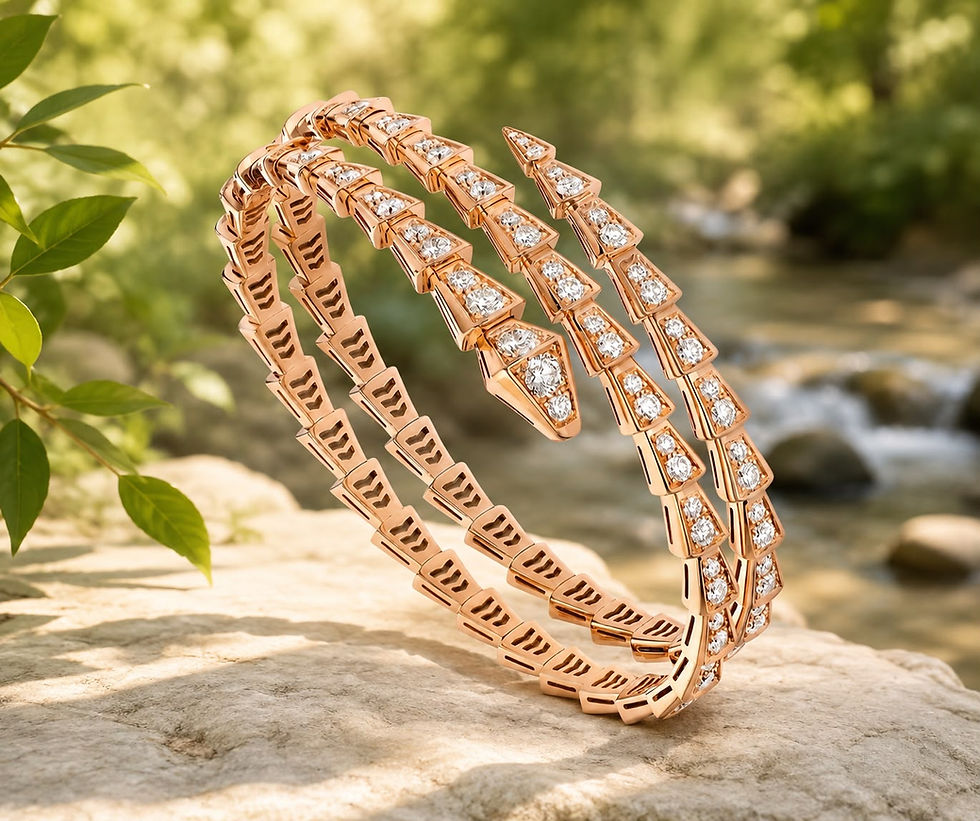
Serpenti bracelets use many small movements rather than one dramatic hinge. Linked or articulated elements bend together, allowing the body to follow the wrist while maintaining the taper and rhythm of a serpent.
Tension is equally important. A well-made bracelet should feel secure without becoming restrictive, and it should recover its sculptural shape after being opened for wear. The body must also balance the comparatively dense serpent head so the piece remains correctly positioned.
Double-coil designs are more complex because both turns must sit harmoniously across the changing circumference of the wrist. Their spacing, pressure and alignment all contribute to the final sense of ease
The Snake Head: Where Sculpture Meets Precision
The head is the emotional centre of a Serpenti creation. It determines whether the serpent appears elegant, dramatic, abstract or almost lifelike, while also presenting one of the most technically demanding surfaces in the design.

Unlike a flat jewellery setting, the head slopes towards the nose, widens around the skull and curves down the sides. Pavé diamonds must follow these changing contours without producing awkward gaps or disturbing the outline. Different stone sizes may be used to create the appearance of one uninterrupted field of light.
Gemstone eyes have an outsized effect on personality. Emeralds create a traditional reptilian character, rubies add warmth and drama, while black onyx produces a sharper, more graphic expression.
Surface treatments shape the way the serpent is perceived. Polished gold emphasises form and volume; pavé creates brilliance; enamel makes the scales more pictorial; and alternating finishes can heighten the impression of movement as the wearer turns the wrist.
Some historic Serpenti secret watches added another layer of ingenuity by concealing the dial beneath a hinged serpent head. In these pieces, jewellery, sculpture and watchmaking became one object.

Serpenti Necklaces: Making Gold Drape Like a Living Body
A Serpenti necklace must respond to gravity across the collarbone and chest while remaining visually balanced. A completely rigid gold serpent would lift away from the body and concentrate weight at only a few contact points.
To create a natural drape, the body is divided into articulated sections. Each element contributes a limited degree of movement, allowing the necklace to curve around the wearer while keeping its decorated surface facing outward.
The serpent head is usually the heaviest and most visually important component, so its weight must be carefully balanced to prevent it from rolling or pulling the necklace out of alignment. Closures and joints must also remain discreet so the body appears continuous.
In exceptional high-jewellery examples, hundreds of articulated elements may work together. The achievement lies in making that complexity disappear, leaving the impression of one uninterrupted creature.

Why Serpenti Feels Alive
The illusion of life does not come from one moving component.
It emerges from several carefully balanced qualities.

Repetition
Scale follows scale, creating the visual rhythm of a reptilian body.
Taper
The gradual transition from body to tail or head makes the form feel anatomical rather than assembled.
Controlled movement
Each component moves only as much as necessary, but collectively the piece becomes supple.
Tension
Coiled pieces gently resist opening and recover their sculptural shape.
Surface variation
Polished gold, pavé diamonds, coloured enamel and gemstone eyes respond differently to light, making the serpent appear to change as the wearer moves.
Weight
The piece must feel substantial enough to communicate preciousness, yet sufficiently balanced to remain wearable.
Serpenti therefore succeeds because its mechanics and aesthetics are inseparable. The articulation is not hidden beneath the design—the articulation is the design.
Details Collectors May Notice
Scale rhythm — The proportions and direction of the scales guide the eye towards the head and create movement even when the piece is still.
Head placement — The head often sits slightly proud of the body, giving it dimensional authority and preventing the face from disappearing into the coil.
Pavé and perceived volume — Diamond-set scales reflect more light and may appear fuller than polished-gold sections of similar proportions.
Controlled adjustability — Flexible does not mean infinitely adjustable. Serpenti pieces are designed to move within a prescribed range.
Wearability — A Serpenti is not fully successful unless it sits properly on the body. Comfort and balance are part of the craftsmanship, not secondary conveniences.

Curator’s House Note
When most people first encounter a Bulgari Serpenti, they notice the obvious drama: the scales, the diamonds, the pointed head and the suggestion of a snake winding around the body.
What becomes more impressive after handling one is the restraint behind its movement. A well-made Serpenti does not fall loosely like a chain, nor resist the wearer like a rigid sculpture. It yields only where it is intended to yield. Its head remains composed, its scales stay aligned and its weight feels deliberate.
Tubogas may be the purest expression of this idea. A technique inspired by industrial piping becomes warm precious metal coiled around the wrist—simultaneously modern and ancient, mechanical and mythological.
A Serpenti is therefore not simply jewellery shaped like a snake. It is a carefully orchestrated negotiation between rigidity and movement—one in which metal is never truly softened, yet somehow learns to slither.


Explore More Bulgari Jewellery Curated by WLCSG:


Comments